

Moving Beyond “Fabric First”: A Pragmatic Approach to Scottish Decarbonisation
At Loco Home, we believe that accelerating decarbonisation requires not just technical expertise, but the courage to challenge established industry norms when they no longer serve the urgency of the climate crisis.
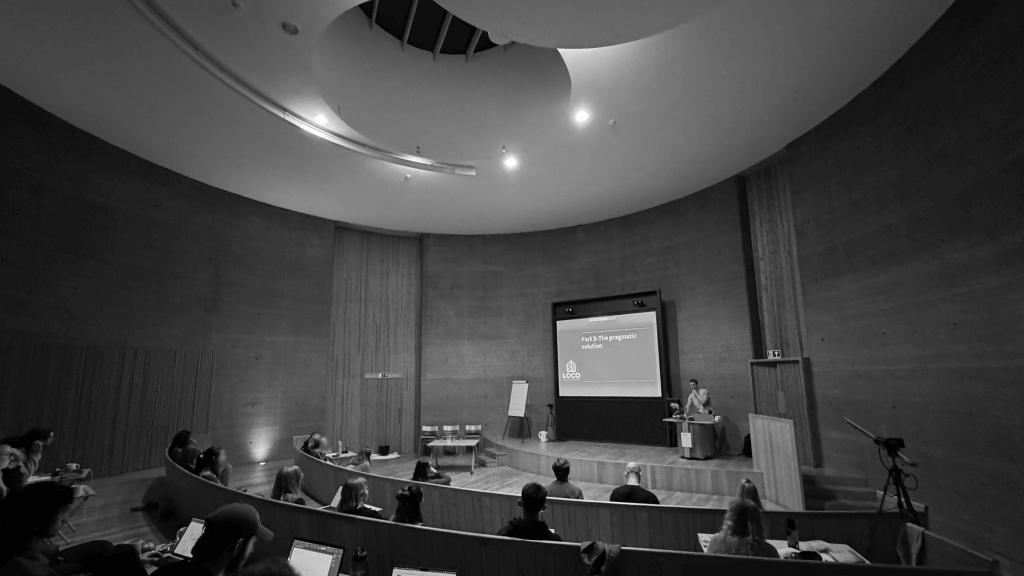
Recently, Loco Home’s Supply Chain Manager, Angus Brodnax, returned to his alma mater, the renowned Centre for Alternative Technology (CAT) in Wales. A former joiner turned MSc graduate in Green Building, Angus visited to deliver a lecture to the current cohorts of MArch and MSc postgraduate students.
While CAT is celebrated for its foundational work in sustainability and its adherence to the “fabric first” ethos, Angus’s lecture—titled Heat Pumps in Retrofit: Moving Beyond Fabric First—offered a vital, emerging perspective. It is a perspective born from the practical realities of retrofitting Scottish homes, distinguishing theoretical models from the on-the-ground experience of reducing bills and carbon emissions today.
Rethinking the Hierarchy of Retrofit
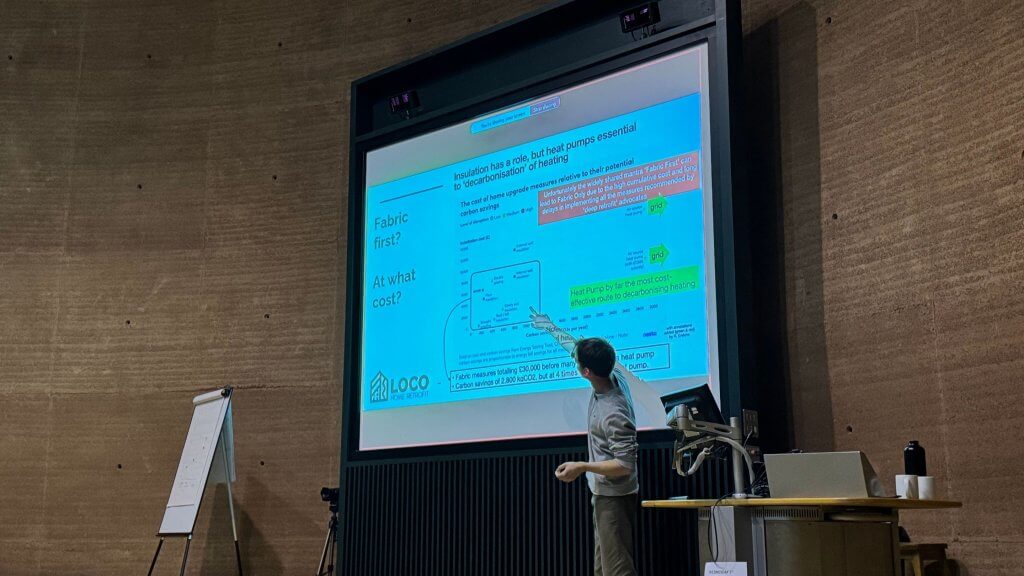
The traditional “Fabric First” doctrine dictates that a building envelope must be insulated to very high standards before low-carbon heating is considered. While logically sound in a theoretical vacuum, Angus argued that this approach is becoming a barrier to progress in the face of a climate emergency.
The data supports this shift. Over the last decade of fuel poverty schemes and insulation drives, domestic gas consumption has barely shifted. Furthermore, some schemes such as ECO are plagued by compliance issues regarding External Wall Insulation (EWI), with reports from the National Audit Office suggesting high failure rates in sampled installations.
As Angus demonstrated to the students, a heat pump can immediately deliver an approximate 80% reduction in carbon emissions for a typical home. To achieve that same reduction through insulation alone would require an “EnerPHit” (Passive House Retrofit) level intervention, costs of which can be £1000-£1500 per square metre. By contrast, a heat pump installation costs a fraction of that capital sum and delivers the carbon savings immediately, while the grid continues to decarbonise toward 2030.
Fabric condition rather than ‘Fabric First’
This does not mean Loco Home advocates ignoring fabric.
Rather, before installing a heat pump, the priority for any household should be:
- Structural Integrity: Ensuring the building is wind and watertight.
- Resilience: Preparing the fabric for a climate that is becoming wetter and windier.
- Health: Ensuring adequate ventilation to prevent mould as buildings become more airtight.
Once a building is in good repair, and basic measures like draught-proofing and loft insulation are secured, a heat pump is often the most pragmatic next step. The obsession with deep retrofit measures, particularly solid wall insulation on stone tenements, is often unnecessary. In-situ testing by Historic Environment Scotland has revealed that traditional pre-1919 stone walls often retain heat significantly better than standard calculations assume. In addition the cost of robust solid wall insulation can outweigh the energy savings and consume available funds, indefinitely postponing the investment in full decarbonisation with a heat pump.
The Myth of the “Hard to Treat” Home
A significant portion of the lecture addressed the myths surrounding homes deemed “unsuitable” for heat pumps. The industry often labels rural properties or older stone buildings as “hard to treat.” Loco Home’s experience contradicts this.
In reality, rural off-gas properties often present the strongest business case for heat pumps. Furthermore, the argument that heat pumps cannot function in cold climates is dismantled by looking at our European neighbours.
Countries like Sweden, Finland, and Norway—which experience significantly colder winters than Scotland—have the highest uptake of heat pumps in Europe. The driver is not climate, but economics. These nations have a favourable “spark gap” (the ratio between electricity and gas prices).
While the UK’s price ratio is currently higher, pragmatic solutions exist today to bridge this gap:
- Time-of-Use Tariffs: accessing cheaper off-peak electricity rates.
- Smart Integration: utilising solar PV, battery storage, and smart controls.
- High Efficiency: Ensuring high Coefficient of Performance (COP) through quality design.
The Future is Data-Led
Angus concluded his lecture at CAT by looking toward the future of the industry. He believes the next phase of decarbonisation will likely move towards “Comfort as a Service,” where sophisticated data monitoring ensures homes remain warm at the lowest possible cost, potentially removing the upfront capital burden from the homeowner entirely.
However, this future requires trust. It requires intermediaries who understand both the data and the unique characteristics of Scottish housing stock—from tenement flats to rural detached homes.
Loco Home remains at the forefront of this transition. By moving beyond rigid dogmas and focusing on what actually works for households, we are proving that decarbonisation can be accessible, affordable, and effective right now.
Are you ready to explore a pragmatic route to a warmer, lower-carbon home? Contact us today for a consultation.